
 The Spectre of Alexander Wolf by Gaito Gazdanov (translated Bryan Karetnyk). When is someone you killed dead? Mystery, guilt, love, philosophy, and death in a very Russian thriller. This review first appeared in Nudge Books (now NB). Continue reading
Author: fishmandeville

School, war and disaffection

It’s natural for us to assume that the Great War was not just a formative experience, but the formative experience for anyone who fought in it. We also tend to assume that the experience was disillusioning at best, and psychologically ruinous at worst. The truth is, unsurprisingly, more subtle and varied. Continue reading
Share this:

An early glass of Christmas something

Sometimes it’s useful to have some help easing through the early parts of Christmas day. This calls for a special kind of drink, if it’s drink you want. The principles are simple enough, but they require fine balance and nice judgement. Your drink should be apt to the season, it should be mild and undemanding, and it should set you up for the rest of the day. Let’s say that you could drink it mid-morning while unwrapping presents (if you have youngish children—ha!) or jawing harmlessly with the in-laws in that dead time before the food. If it seems unhealthy to be drinking before the sun hits the yardarm, at least it’s social, healthier than everyone withdrawing into their smartphones while one person cooks. Continue reading
Share this:

A cocktail for all seasons, especially this one: the Sidecar
 The Sidecar is one of my three favourite cocktails. Sometimes it’s at the top and other times it’s not, but it’s always there. I discovered it by happy accident one Christmas when my father said I could pick any cocktail from his pocket bar guide and he’d mix it for me. I’d been helping out at the guest house, I think cleaning or restocking the small bar. Being very young at the time I looked for one that had the most alcohol and the least mixer without being either impossible (exotic ingredients, such as absinthe) or disgusting (vile ingredients, such as absinthe). I chose a Sidecar and was relieved to find that I liked it; I’ve been liking it ever since. Many cocktails come and go, but not this one. Continue reading
Share this:

Fury, angst, cock-eyed history, Dame Janet Suzman and ancient Greek theatre

Dame Janet Suzman recently made some cock-eyed remarks about theatre being a ‘white invention’, it coming from the (ancient) Greeks via Shakespeare, provoking a lot of fury, angst and uncertain history. I’m not going to add to the rage, but I will say something about the Greek side of the question. Continue reading
Share this:

Sore shoulders in the boardroom: The Apprentice

For some reason everyone in The Apprentice refers to what’s happening as ‘the process’. I like it because it’s so pompous, while the process itself is hard to define. Just what are they doing? Continue reading
Share this:

Beef, beans, paprika and thyme
 Spanish-ish beef and bean casserole

It’s the time of year to say something about the nights drawing in and it being colder, this requiring hearty comfort food and all that. For myself, I like this casserole at any time of year and think it quite suits the summer, but it is hearty. It can be a simple, economical meal, but it’s also good enough to give to old friends with some good wine. Continue reading
Share this:

Do they know Xmas isn’t wrong?
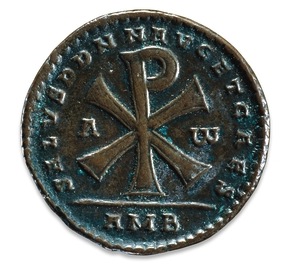
Some people get awfully sniffy about Xmas as shorthand for Christmas. Wretched modern world, proto-textspeak, irreligious, ahistorical, next they’ll be calling it Pepsi-day.
As it happens, Xmas has been in use in English for centuries, and is recorded in a letter by the poet and polymath Samuel Taylor Coleridge. The ‘X’ stands for the Greek letter chi; in (ancient) Greek Christ is ‘Χριστός’. This abbreviation for Christ (often using the first two letters, chi and rho, Xρ) was common in ancient Christian artwork; it has an exceptionally long pedigree.
It may not be recommended for use in formal writing, and most publishers’ style guides are agin it, but it isn’t illiterate or crudely secular, a symptom of the commercialisation of Christmas.
Merry Χριστόςmas, everyone.
Paul Fishman (Bristol, December 2014)
(For more on the coin and Christogram see here.)

 Paul Fishman